Sunday, 3 May 2015

Expo Awards Day 2 - Sleeper – Orphans of the Cold War


The second entry to the awards this year has been a number of years in development and was one of the RPG entries in the Dragons Den at Expo last year.  Sleeper takes place in a world where the various supersoldier programs that were running at the time of the cold war didn’t come to fruition while the war was still on.

But they’re up and about now the war is over…


Good premise and written in lively style, the background paints an engaging picture of soldiers with powers beyond those of mortal men engaging in rolling battles over objectives that not even they know the relevance of.  There is an interesting range of powers available through the book and many of them are anything but mundane in their nature.  An example of this would be (and every group picked it out, which is why it’s appearing in these notes) Entrail Burst, wherein the character gets to try and attack the enemy with their own entrails…Or tie them up, using their own entrails…or…

You get the picture…


With such imagery present, it can’t be said that the game is for children, and there is a mature players advisory in the opening pages that is well earned by a short read through the background material.  With this in mind, the teams moved on to the rules and found something that polarised the opinions of the judges.  The basic rules for skills are roll versus target number with a variety of modifiers, but it was the combat rules where the difference of opinion occurred.  The combat rules are designed to take place on a board, with modifiers for almost every conceivable possibility that could enter into the equation, and rather than flowing quickly as the single skill roll for the main skills does, the modifiers system does slow combat down to the point where plotting distance and tactical play take up a good portion of each combat round.

Those who were very much in with the flowing nature of the basic skill tree and the background found this to be a little jarring when it came to switching out of Roleplaying mode and going into Wargame mode (to put it in perspective, there’s less rules in Warhammer 40k than there are here), whereas those who saw the game as an extension of how these agents would be trained to fight thought that it was an excellent addition and well matched the idea of the game.


On the subject of artwork, the teams were aware that the copy sent to us for the awards was an advance release, and that the finished product may have more artwork in it, but there was a level of disappointment after seeing the excellent front and rear covers to find that most of the artwork in the book was either of the characters, or of a single scene that gets repeated at another point in the book.  Layout is otherwise well done, plenty of content in the near three hundred pages.

And with that, we’re on to the Judges comments

Fantastic premise, plenty of atmosphere, doesn’t flinch from presenting the world as a dark place full of shadows.

Not sure If it’s a tactical game with roleplaying elements or a roleplaying game with tactical elements, It’s possible to do combat without the board, but it doesn’t work as well.

If there’s going to be a miniatures game to support this, I’ll be buying it, but a lot of crunch for an RPG.


Saturday, 2 May 2015

Expo Awards Day 1 - The Code of Steam and Steel


The first submission (literally, turned up two days after the submissions opened) for the expo awards this year comes from a long term stalwart of the UK games industry, Simon Burley, with his latest game engine, the Code of Steam and Steel.  It’s to be noted that while this is a complete game engine, it requires a world to work with, there is no world provided with the rules and no notes on how the author envisages the system working.

With that in mind, lets take a look at the system that’s been provided...

Three abilities that can be literally anything at all, these define the abilities and specialities of the character, what they are good at and what they aren’t so good at.  There is a list in the back of the book of examples of skills and ideas that can be put forwards for the character if the players can’t come up things for themselves.  These are generated from the numbers one to six and in turn are used to generate the other three statistics that determine the characters particular levels of resistance.  None of the judging teams had seen anything like it before, there’s points based generation systems and there’s freeform systems, but never something that makes a mix of both. 


System is D6 based, uses target numbers that are clearly defined, but also places a strong emphasis on narrative elements making all the difference when it comes to the game itself.  This was very popular amongst the more experienced playtesting teams, less so in the newbies.

There’s not much artwork in the book, and the artwork present is mostly clip art, it puts across the idea that the universe this was designed for was steampunk, but it doesn’t go beyond making that point.  The front and back covers are the only colour artwork and while they’re excellent images, the lack of specific artwork and images was noted by all the teams.  Layout is well done, there aren’t masses of white paper leaving holes in the product, tables are unobtrusive, and there’s plenty of content on how to run the game, how to make things interesting, how to build interest villains and plots, and how to keep players interested.

What there isn’t, however, is a world to play in...


We touched on this at the beginning of the comments, and while the book makes no apologies for the fact that it is a set of rules with only a single adventure in them to tide the players over with, the lack of a strong game world is felt, particularly so when the rules make playing the game so easy.  It was the considered opinion of all the teams that with a fleshed out world, this would be a product that could easily rival a number of the larger RPG houses, but with the GM needing to transplant their own world or use the setting from another system, it does present the a large gap in the appeal for beginners.


On to the Judges comments:

Less than a tenner for a truly original system that combines well dice and narrative playing, easily on my top ten purchases of the year.

Would be better with a whole world behind it, it’d be nice to know what world the author was thinking of when he wrote this.

I’d have liked more to start the players off with, but there’s enough for a good GM to work with.


Excellent game, easy to reference, fast to generate characters and faster to play, one for my group this year for sure. 

Friday, 1 May 2015

UK Games Expo RPG Awards 2015


And the list is as follows


The Code of Steam and Steel by Simon Burley
Mutant Year Zero by Modiphius Games
You are the Hero by Jonathan Green
The Long Con by Adam Gauntlett
River of Heaven by John Ossoway
Hellfrost Rassilon Expansion 2 by Triple Ace Games
Sleeper: Orphans of the Cold War by Death Spiral Games

As always, we keep the judging on five different criteria


Quality - Not just the amount of shiny art in the book, but how well it's been laid out, is the artwork appropriate to the subject matter, does the book feel like it's going to fall apart...  Does it feel like something that'll still be intact in ten years time...?


Theme/Originality - Is it the latest clone of a clone, or is it something new, something that makes a big difference in the RPG world, is it something everyone's seen before with a new skin...?

Balance - Is the game balanced, are there equal reasons to want to play the different character types, or does everyone want to be a Black Numenorean...?

Playability - As well as the balance, does the game play well, do the rules get in the way of the setting or do they complement it, when someone says it's innovative, do they mean that it's never been done like that or that it's never been done like that for a reason...?

Value - With costs always going up, the question of value is always asked, if you're putting something out for a tenner, it stands to reason that you won't have the production values and quality of something that costs a hundred, but regardless of anything else, is this something that is worth what's being asked for it?

First commentary is starting tomorrow, with one a day till we're through all the entries, as always, the public votes made at Expo on the day make a big difference in who eventually wins...

Thursday, 30 April 2015

Day one on the BBW trail...

And while the headline will probably have got a whole bunch of people here expecting something completely different, It's nothing so exotic...

BBW in this case is Big B'stards Walking, something that I suspect will be done a great deal more in the months to follow, because I (and at least one like minded soul) are looking to keep moving and improve things in general whilst avoiding the perils that come with having to sit down as much as we do.  With this in mind, a bunch of walking was suggested, and we thought that to make things a little better, it should be done with the idea of doing it more often, and herein lies the problem for a number of Big B'stards, because...

1:  Walking isn't very interesting, the scenery goes by too slowly and it often rains...
2:  If you're walking and you're built like me, it's more like a merry amble, and while that's fine for me, any lycra clad fitness nutjobs are likely to be complaining that I'm going too slow...
3:  It's a problem for most Big B'stards to explain that, yes, you are breathing more heavily, and yes, you may look a little pink, but you're not falling over, and you're still going.  The reason you're breathing more heavily is because you're pulling more of you around, and the reason you've gone a little pink is because you're built this way and that keeps you insulated... It doesn't mean that we're having a bad time, but it's an irritation when everyone keeps asking you if a cardiac is on the way...if you're walking with another Big B'stard, they know the score and you don't get stupid questions :)
4:  Did I mention it often rains...

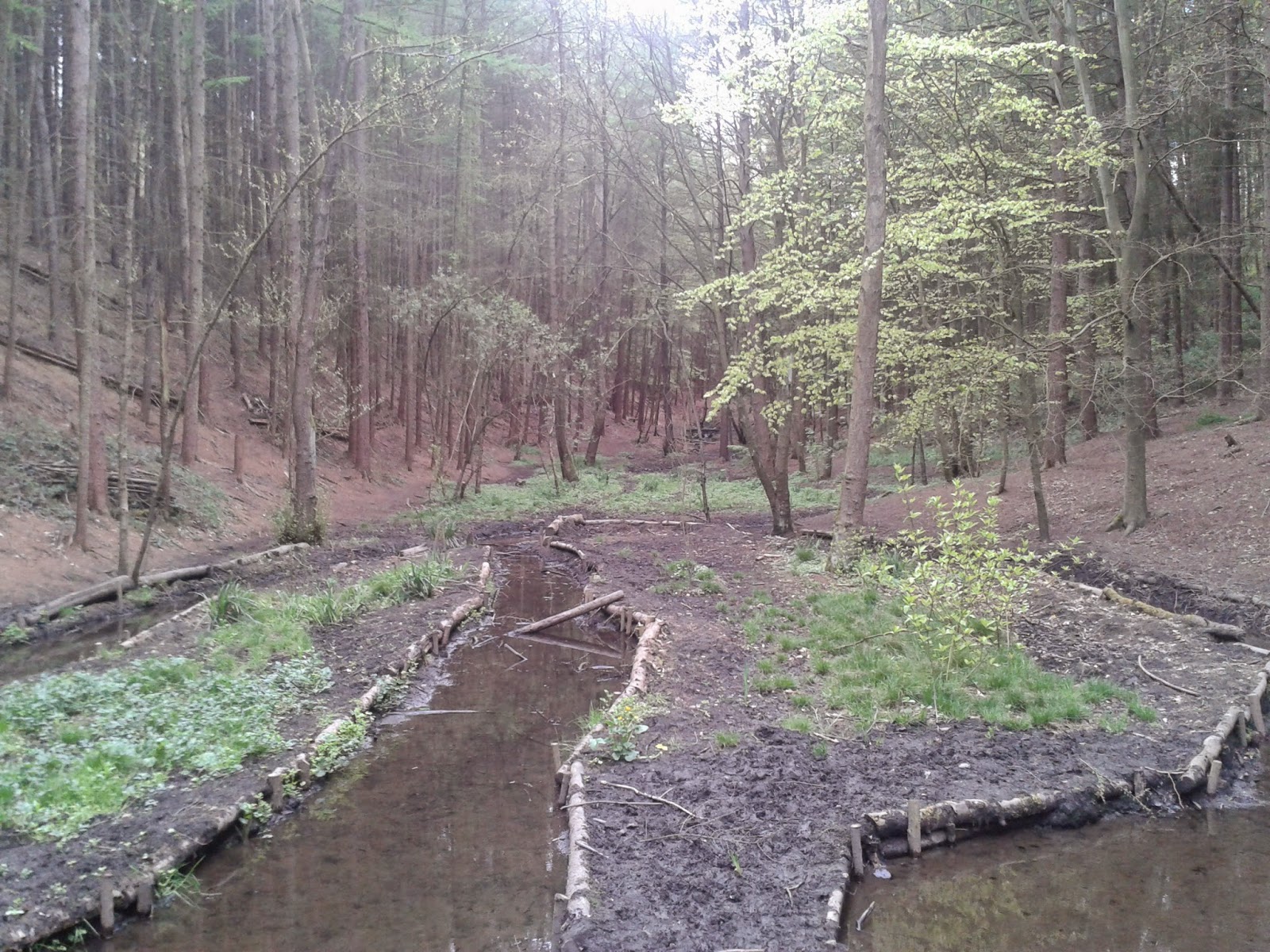
So with this in mind, we decided to take a walk around Newmillardam in West Yorkshire, the low road for the first day, with the idea of building up as time goes by, set off around at a good clip, him wearing sensible walking gear, me having turned up in a bomber jacket (in summer, on a hot day, error...), got halfway around and found that they'd changed a few things, specifically the addition of a wooden walkway into the boggy areas...

Clearly this was a sign...


So we wandered down to investigate and found that it went deep into the forest and ended up in a platform that looked like the point to defend, against...wild ducks perhaps....


and then back out, whereupon we agreed that truly righteous nerf wars could be held here, you'd just have to worry about footing the bill for overloading the water with blue darts.  Given that both I and my fellow walker are both writers, we spent a good hour taking a stroll around the lake and beyond into the fields and then back, and all the way talked of writing things and projects and ideas, which is always helped when you encounter things that fire the imagination...


Yes, that is a house built on the side of the lake with the lower levels submerged...

Cue the pair of us trying to find a way in...

In all, we didn't get round in record time, I'm sure it's possible to run in ten minutes what we took an hour to walk around, but that wasn't the point of the walk, enjoyed it greatly and we've agreed to do it again in the near future, at which point there'll be another post from the BBW club...

Wednesday, 29 April 2015

Longcon - A new All Day gaming convention in England - Convention details...


A short while back, I mentioned the possibility of making a convention that celebrated the longer games, the games that you spent all weekend playing and didn't have to run between slots to get to the next game because each day was all about the one game...

Things have moved on a little since then...

Finally managed to get a holding page put up for the convention and some of the games loaded in, with the full details of where the convention is going to be, how you book, where you can stay, and where you can ask other questions, it'll be changing when we get the domain sorted, but for now, it's at...

http://doddherderofcats.wix.com/longcon

Any questions, we're going live in a week with all the other games in place and the booking system going live, ask away...

Friday, 27 March 2015

Cthulhu Masters at Expo

Just a sneak peek for those who aren't watching the facebook updates at Expo, some of the prizes for the Cthulhu Masters this year.
Because no prize is complete without a box...

And where would Cthulhu be without sinister Idols...

Or Cryptic Letters...

Or photos of things that may never have happened...
And with great glee, I can report that Yog Sothoth have kindly sponsored the masters this year with a copy of The Express Diaries for every person who enters the competition this year.


Booking for the tournament opens at 22:00 this evening and places are sure to go fast

Friday, 20 March 2015

And I've let the blog go a little...

Problem inherent when you're organising so many things, some of the things that aren't immediately essential go by the wayside, but I need to start coming back to this anyway, and in doing so, I might get some of the impetus back.

But not tonight, tonight I sleep alone, for Tiny wife is in deepest darkest London, and my world is a emptier place without her...

So this is John Dodd, in the Socialist Republic of South Yorkshire, and Goodnight England, Wherever you are...

Monday, 9 March 2015

Star Realms - Game Review


I’m a latecomer to Deckbuilding games in general, it was only last year that I came across Dominion, and that was my introduction to the concept.  I have to say that as far as game ideas go, I really like that both players are working from the same deck and have access to exactly the same resources at the beginning of the game.  The only problem I ever had with Dominion was that you didn’t really know who was winning till you get to the end of the game and tally up the points, so you don’t tend to adjust your strategy to reflect that.

There is no such problem with Star Realms


Star Realms is a two player deck building game that has all the cards you’re going to need in the base set, it works on a similar premise whereby players buy cards from the centre of the table and build their deck up to do what they want, but instead of victory points being placed within the deck, the winning criteria for this game is reducing the opponents Authority (Hit points) to zero.
 
And as with all Authority, it can be overturned...

The mechanics of the game are almost identical to those of Dominion, players start with two vipers and eight scouts, vipers do a single point of combat (damage) and scouts provide a single point of trade.  Players start with a hand of five cards, they get to buy as many cards as they can afford in the turn, then play any combat effects, then discard all their remaining cards and draw another five.


There are some subtle difference to Dominion in the way the game plays that suit the style of the game very well, the first of which is that there’s no limit to the number of cards that you can buy in a turn, if you have the trade points available, you can keep buying till you run out.  There’s a pile of cards separate to the main deck which is made up of Explorer ship cards.  These are worth two points of trade rather than the one of the scouts, so there’ll always be things that can be bought at the beginning of the game, even if the cards drawn from the main deck are initially too expensive.


The main deck consists of ships and stations, with each faction having a particular focus towards how that faction is played and what it will work well with.  No card has a play cost, if they’re in your hand, you can play them, ships go into your discard pile when you’re done with the turn, but stations remain to be used again and again.  The only defensive measures you’ve got against incoming fire from the other player comes in the form of outposts that absorb a certain amount of damage before being destroyed.  When destroyed, the outposts go back in your deck and will eventually come around again, but you have to balance carefully your offense and defense. 

Most cards have more than one function to them.  All cards have a main effect, and that effect occurs whenever you play the card, but many cards also have an Ally effect and/or a scrap effect.  Ally effects come into play if you have another card of the same faction out at the same time, and scrap effects can be used at any time, but to use it, you have to put the card in the main deck discard pile, not your own, so you only ever get to use it once.

The trade pile always has five cards in it at any time, as soon as one is bought, it is replaced with another from the main deck, and there’s no danger that the main deck will run out before one side has battered the other one into space dust.  

There are four factions within the basic decks, each one having a different style of play


The Blob faction (Green) are an organic battle fleet that works by delivering lots of damage and drawing additional cards with which to press the advantage.


The Trade Federation (Blue) are the main defensive fleet, their ships offer lots of trade but also raise your authority level so that you can keep going even though you’re taking hits from other fleets.


The Star Empire (Yellow) are a direct attack fleet that don’t deal the same levels of damage as the Blob fleet, but have additional damage in the form of causing the opponent to discard cards from their hand so that their next turn will be reduced in what they can do.


The Machine Cult (Red) are all about efficiency, most of their cards have the ability to remove cards from your deck or discard pile to streamline its efficiency, the larger of their ships allow you to remove things from the trade pile in the middle of the table.  

It’s very difficult to build a deck that’s completely one of the factions, the trade deck being properly shuffled tends to have ships of all different types coming up, so working out which combinations work for you is an important thing early on, diversifying will only give you a deck that doesn’t work too well, but most decks with two factions in them can be very efficient.


The artwork on the cards is excellent, all brightly coloured vistas with a clear idea of how big the vessel you’re playing is, and I don’t know about everyone else, but I like the idea that even though all the cards are the same size, you get the idea that you’re playing something massive when you slap a dreadnought down, far more so than you do when you’re playing a viper.

Playwise, there’s no one faction that’s stand-out overpowered, and there’s a lot of work been put into the balance of it.  There’s expansions for the game that I haven’t picked up yet, but I’m sure I will be, and while I know that a self contained game doesn’t need expansions, I can’t help but think that this game could easily support more factions (even if the trade deck replaced one faction for another completely), and that the game would only benefit from greater diversification.


Available directly from White Wizard Games at http://www.starrealms.com/ they also have an app for playing the game when there’s no one else about.

Sunday, 8 March 2015

Why things shouldn't be spun out, but kept fresh and live...

I don’t read the various Horus Heresy novels, I started out reading them with the best of intentions, but it was eight years back when I started, and after the first few, I came to the realisation that like many things games workshop, they were just going to milk it for all the money they could before bringing it to an end.

It’s not that I object to them making money off their own IP, I just have a problem when it’s something that everyone already knows about, everyone knows how it started, and everyone knows how it ends, and they knew that more than twenty years ago.

Especially after how it was first told...

Behold White Dwarf 131…


Without question, my favourite issue of White Dwarf ever, mostly for the fact that it had two of the best pieces of fiction that I’ve ever read in it, and another reason, that was only to become apparent in later years…

The first piece of fiction was The Emporer and Horus, by William King, which detailed the last hours of the Horus Heresy, when the Emporer took the fight to Horus and nearly paid with his life…

It took two pages…


There was nothing wrong with that bit of fiction, it was tight, sharp, and encompassed all the things it needed to do, it conveyed all the emotion that was going on and the gravity of the situation, it conveyed the end of a struggle that had been waged across a galaxy…


It took two pages…

As of right now, the Horus Heresy saga spans 13093 pages, not all of which is immediately related to the events of the Heresy, some of the books deal with minor incidents out in the middle of nowhere, some of them deal with events that had no apparent (as of now) bearing on the events of the heresy, and some of them are very relevant to the heresy, but take a while to get to the point.  In all, there’s a number of other books planned, and most of the GW employees that I’ve spoken to either have no clue when it’s going to be finished, or aren’t allowed to tell people when it’s going to be finished (much in the same way that you can’t refer to mark 6 armour as womble armour anymore), so it’s going to keep rolling till they announce that the next book is going to be the last.

And you can be sure that it’ll be written by Dan Abnett, which is a good thing.

But I can’t help but feel that this could have been done tighter, sharper, and then the books could have moved on to other, newer fiction, on subjects that we don’t know about, maybe even…

Something original…


Which brings me to the other piece of fiction in this issue, Inquisitor Kryptman by Lindsey D Le Doux Paton, which detailed Kryptmans encounter with something that resembled a Grabber Slasher (as they used to be known), and the final moment of the story, where they make contact with the Scythes of the Emporer, and the contact is too much…


“Warn them, WARN THEM, the tyranids are coming, THE TYRANIDS ARE COMING…”

More emotion packed into one statement than the rest of the story put together, and it’s things like that that stay with you when you read, I’ve never forgotten either of those stories, nor the artwork that went with them, and they mean more to me than all thirty of the novels that have been brought out since, because they resonated with me, and since that point, I sought to make my writing more like that, because words are like anything else, a small number of the right ones will make up for any number of the wrong ones…

And I believe that with all my heart, if people spent more time doing new, original things, and inspiring people to buy them because they were interesting and new, the world would be a better place, and stagnation would be a thing of the past, it’s not as easy as making something 6547 times longer than the original story, but it works better…

Rant over…

The other thing about this episode though, is the featured store in the front cover, and a man I was to come to know well…


Although I’m not sure about the hairstyle, reckon he looks better now :)

Saturday, 7 March 2015

World War Kaiju - Book Review


I love big monster films, so does Tiny Wife (more than I do in point of fact), I particularly like them when they play the monster as being something largely unstoppable (which they would be), and I like it when people put thought into what they’re doing and don’t just head straight for the fight scene (or have swan diving godzillas, 1998 pay attention), so when Pacific Rim came out, it was on the must see list, and remains one of my favoured films of all time...

But there aren’t enough Giant Monster films out there these days, and the ones that there are tend not to involve the Giant Monster all that much.  Anyone see the recent Godzilla film?  Two hours of film and only ten minutes of Godzilla, what’s wrong with this picture...?

So it’s always pleasing when you find something that’s got a Giant Monsters and a bit of plot work to go with it.

Enter World War Kaiju...


I’d already taken a look at this when it was at the Kickstarter stage, but as I’m sure many of you can sympathise, I spend too much time on kickstarter and occasionally rein myself in, even when the shiny is so bright I can almost taste it...

However, they did kickstart it, it did do well, and from that, they released a number of copies into the world, so I got a copy for Tiny Wife...


Stop looking at me like that, I really did get it for Tiny Wife...

The fact that I found it brilliant too doesn’t come into this, it’s her book...

Seriously...

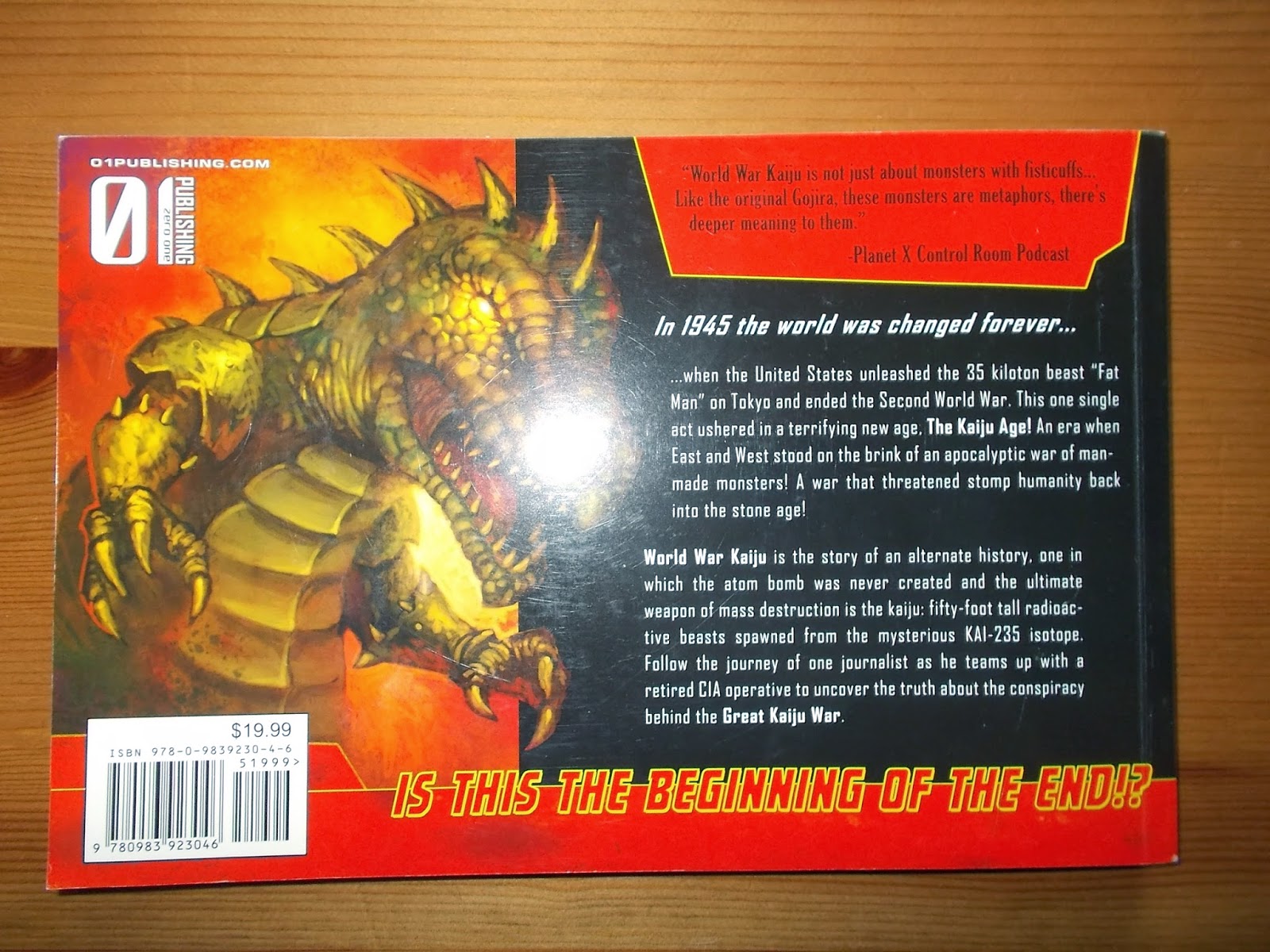
The story is told in flashbacks, as a reporter questions a soldier on what happened in the final days of the war.  It’s an alternate universe story, where instead of dropping Fat Man, the atom bomb, the Americans found a way to drop Fat Man, the Kaiju...  Before long, other countries were experimenting with this new technology and before long, there were Kaiju popping up everywhere. 


The story itself is fairly simple, and makes up most of the drawn elements of the book, with a reasonable amount of text in between made up of reports about the operations, scientific calculations, formula’s, and the general sort of random snippet that really interest me. 


There’s a whole world dreamed into this book, and I suspect that this first book has just scratched the surface of it.  There’s a website devoted to the comic, dividing the known Kaiju into their respective countries or alignments, so you’ve got American, Soviet, Nato, and Rogue Kaiju, none of which have any allegiance to that country, only the understanding that that country has (what they think anyway) control over them.


It's available at the moment at www.worldwarkaiju.com

I liked the book a lot, it doesn’t take itself seriously, but it has enough reverence for the subject matter to not make it a joke, I know there are plans for a second book at some point and this time...

I will be backing it on Kickstarter...

Friday, 6 March 2015

Stealing Cthulhu - Book Review


So who’d want to do that?

No one sensible one presumes, after all, even if you manage to steal it, what are you going to do with it?


This is a book by Graham Walmsley, originally published back in 2011, which details the finer points of Gamesmastering for Call of Cthulhu.  It’s not often that I read a book on gamesmastering, and to be honest and fair, most of the time, I don’t feel the need to.  I’ve been running games for more than twenty years and running them well, so like most people who’ve been doing something most of their lives, while I’m open to new ideas, I have a reasonably healthy conceit that I’m not going to find any.

Cheerfully proven wrong in this case...

Reading this book has reminded me of how much I did learn in the early years, how many times I found something new and it was like Indiana Jones discovering Tanis for the first time.  When you start GMing, you don’t know anything, you figure that being God is easy and the path goes one of two ways.

1: They start acting with impunity, nothing can stop you, and you can do anything, these GM’s never make it more than a few years, players won’t put up with them and it won’t be long before they find themselves either as a player, or at a table of one...
2: They start learning, and every lesson they learn makes their games better...


This book is for those who intend to walk the second path...

The book starts with a basic premise, the understanding that most Cthulhu games follow a particular theme, one that starts with Investigators finding something strange, things go bad, things get weird, the mythos shows up, everyone goes mad...

Shooting commences...

And that’s also the problem with most Cthulhu games, if you play it that way, it turns into Paranoia with added tentacular complications.

There’s a lot of people out there now saying that I’m wrong in saying that it’s not how the game is played.  In truth, yes, a lot of people like to play Cthulhu like that, and if that’s how you like to play it, then have fun, play your heart out and never think anything more of it. I see Cthulhu as a setting that gives you the best chance to have an involved game against impossible odds, but like all things I come up with, it’s my opinion, and you can take it or leave it as you see fit. 

But here’s why I think that Tentacular Paranoia is the wrong way to play it...

If you read Lovecraft, those who were involved in the story often made little difference to the outcome of it, they were incidentals, bystanders almost, as the mythos creatures went about their undecipherable plans.  They were mostly powerless in the face of what happened, and the notion of turning up with guns or secret knowledge conveniently gleamed went out the window when the first page turned.


And that’s a million miles removed from most Cthulhu games, where investigators turn up, already know the stats for whatever they’re facing off against, and have no concern over what it is beyond the finishing of it.  The problem is that there’s too much information out there, and most savvy players know all about it, so the only thing they have to worry about is the failure of a SAN check, and everyone opens fire...

There are some who don’t run games that way, and doing the job I do for UK Games Expo, I see those people every year, I know their games will sell out almost instantly because the experience of playing the game in the way it was meant to be played is something that people search out every time after they’ve played it that way, and those who don’t play it like Tentacular Paranoia get their name about fairly quickly.

This book is one of the best resources I’ve found for how to run games of Cthulhu properly, to recapture that sense of fear at the things that the investigators may have to face, to bring something unknown back to the table, and the best part of this is that it doesn’t take much to do it, it’s changing a few things about the world the investigators are in, it’s following the way Lovecraft did things, as the title suggests, it’s Stealing Cthulhu...

And giving it back to your players...

There’s sections on what each different branch of the Mythos do normally, and how they can be changed to work differently, advice on cultists and monsters, when to use each, and more importantly, when not to use them, a distinction that is more important than most people starting out with Cthulhu would believe.

At the end of the book, there’s a set of rules for playing Cthulhu without the masses of rules presented by the regular books, a system that Graham calls Cthulhu Dark.  Replacing all the rules with simple die rolls and working on a narrative basis in a style more reminiscent of FATE than BRP, it works well for experienced players, and the rest of the book provides all any GM needs to get players to that experienced stage.


The theory is that you can’t teach old dogs new tricks, but there is the point that sometimes the dog needs reminding of the things that he learned long ago, sometimes it’s not enough to know something, sometimes you don’t use your whole arsenal because you haven’t used it in so long, and if you’re new to the game, you don’t have the arsenal in the first place, and that’s what I got from this book, a reminder of all the things that make these games excellent.

It’s available from RPGnow or from Grahams website direct at


And unlike Cthulhu, it’s worth paying for...

Thursday, 5 March 2015

The Butcher and the Cleric - Acolyte Miniatures Review

I like games with interesting pieces, from the hundreds of different types of chess sets out there, to the millions of miniatures for wargames, all the way up to the massive pieces used in Cthulhu wars.  I like the idea that the pieces you use to play the game are not only relevant to the game, but also accurate for their use.


That said, there’s a great deal to be said for well crafted miniatures that you can use in a variety of different games, and it’s there that we find the latest offerings from Acolyte Miniatures, the Butcher and Cleric Roberto de Foresta, both ostensibly for a series called the House of Lies and Bones, which by itself sounds intriguing, but which has yet to be expanded on, so I’ll stay to the review of the miniatures themselves.

Both of these mini’s were provided by Acolyte miniatures for review purposes.

Not for Beginners says the packaging

I’d be inclined to agree

The immediate point I’d make is that the detail on both figures is fantastic, the lines are clean, the casting is immaculate, and the main body of both miniatures is sturdy and likely to last well.  I started out with the Butcher, which is cast in 32mm and is larger than the Cleric (down to needing a larger base, which I’ll come to in a minute), but still only has three parts to the whole of the mini, so construction shouldn’t have been a problem. 


Looking at the way the figure is put together, with drilled points at the end of both arms, I expected that the hands would probably have a counterpart section so that they could be fitted into said drill points to make putting the figure together easier.


Not so...

No problem though, out with the modelling kit, snipped off the spare from the end of the hand and tried to fit it...

Still not so...


Sanded it down to flat and fitted it on that way, no problem, and then came to fitting the mini to the base, and that’s where I encountered the problem that it didn’t fit into the base provided, the wording on the mini stood proud of the slot and wouldn’t let the figure descend, sanded it down and it fitted fine, then I took a look on the website to see that the Butcher miniature on the website at


had the same profile, and figured that they must have sent me the same model for my review, particularly as I had one more figure to review...

Which brings me to the Cleric...


Excellent news, this one fit in the base without any problems, very fine detailing on the figure and all the component parts of it (of which there are many).  I considered going with the sword, but considering that the sword was the only one of the weapons that didn’t have a hand already attached to it to attach to the arm and the hand provided wasn’t positioned in such a way that it would hold the sword properly, I went with the hammer.


Easy to put together this time, and both figures are now finished and ready to be painted (which I will not show the results of as I’m sure my painting isn’t up to professional standard) for use in any game I see fit.


The greatest strength of these figures is the detailing that’s been done, they really have gone to town getting all the individual lines and contours well cast, and well painted, these figures would be a boon to any game that’s played with them.  The attachments aren’t the strongest I’ve ever encountered, which is a problem you run with anything that’s very finely cast, but when assembled, you’re never going to be picking them up by the extremities, so that shouldn’t be an issue. 


Which brings me to the matter of costing.

Acolyte are presently offering either of the figures on their website for £12 plus postage, which puts them at less expensive than smaller models in the GW finecast range, delivery is noted as 4-6 weeks from point of order, but the packaging that the two I have arrived in was well sealed and properly foam protected so the figures would arrive safely.


Overall, they’re very nice figures and there’s clearly been a lot of thought go into them.  I’d like to know more about the storyline that they both come from and I’d like to see more on the website regarding what’s coming next (as there appears to be 54mm and 72mm figures coming up as well), but as a start into the market, they’re excellent quality and will certainly find use in a number of games I run.